|
1. October 24 (Sunday),
Mainichi Shimbun special feature article
Today is Sunday. With the aim of killing time with a crossword puzzle, I went down to the first floor and bought a copy of the Mainichi Shimbun at the newsstand. This section was mentioned in Chapter 2.
After finishing the puzzle, my eyes were drawn to the top article on the
front page. The special feature, titled “The Freedom We Have Today: The
Struggle of Former Political Prisoners from South Korea in Japan,” occupied
most of the front page and continued on the entire third page. Normally,
I would glance at the headline and nod, but rarely read the full article
unless it was particularly interesting. But now, things were different.
I had plenty of time on my hands.
I read it thoroughly, taking a break for lunch.
During the 1970s and 1980s, when South Korea was under military dictatorship,
young Korean residents in Japan who were studying abroad in their homeland
were falsely accused of being “North Korean spies” and imprisoned for crimes
they did not commit, resulting in repeated human rights violations. This
was 30 to 40 years ago.
The book follows the life of one such man (now 73 years old), who spent 13 years in prison and, even 33 years after his parole, still cannot shake off the fear and vigilance that have marked his life. I read it with bated breath until the end. It was a rare moment for me.
Such tragedies may not be limited to South Korea. They may be occurring
all over the world. Can Japan be considered an exception? I feel a deep
sense of gratitude and luck that my family and I have been able to live
in peace until now.
2. The efforts of
medical and nursing staff in hospitals
During the hospitalization, I deeply felt the busyness of medical staff,
including doctors, nurses and staff. It was no ordinary situation. The
caregiver who accompanied me from the fifth-floor ward to the first floor
in a wheelchair, where I couldn’t be separated from my drip-feed, and stayed
with me throughout the X-ray examination and electrocardiogram, was also
taking care of another patient. Although there was no neglect, the abnormal
busyness was evident.
Still, the number of patients waiting for tests was staggering. One morning,
Looking at my surprised face to patients overflowing into the first-floor
corridor, someone remarked, “Today is actually a quiet day.”
Patients come in all shapes and sizes, so there are times when they can
be difficult to handle. Regardless, the shortage of staff at the hospital
is undeniable.
Especially in Urayasu City. When I moved here with my family 41 years ago,
the population was said to be 10,000, but now it has exceeded 160,000.
If many of the migrants were around my age, they would now be in their
70s or 80s. The aging population is progressing rapidly. Add to that the
recent COVID-19 pandemic. The shortage of staff at medical facilities is
easy to imagine, and the Juntendo University Urayasu Hospital is no exception.
I couldn't help but think that.
3. Forgetfulness and lack of exercise
I forgot to have the wallet with me. I didn't bring my pedometer. Did I bring my mask? There are countless examples of forgetfulness when going out.
When I get to the kitchen, I forget what I came for. This is a daily occurrence,
but what is more stressful is forgetting people's names, place names, and
the names of things. I can't remember them right away and get flustered.
My wife and I both experience such forgetfulness from time to time. It
doesn't cause inconvenience to others or put us in danger, but it's not
pleasant. We've reached a point where we've almost given up.
My wife turned 80 this September, and I'm one year older. Perhaps we can’t
defy the passage of time.
In the midst of all this, my wife is busy writing haiku, and I am keeping
company with this website, “Viva, Seniors!” I hope it will help prevent
further dementia.
But more important than that is exercise. My wife enjoys tennis with her
friends two or three times a week, and she does tai chi twice a week. She
also seems to be mindful of walking.
Compared to that, what about me? Due to the pacemaker implantation surgery
I underwent this time, I still can't move my left hand freely, so I have
no choice but to refrain from mat exercises and soft aerobics at Dunlop
Sports Club for the time being. It won't be possible this year. So, for
now, Dunlop will be limited to the walking machine and the bath.
Even radio calisthenics are out of the question. How much can walking compensate for?
4. After discharge
From now on, I’ll focus on walking with a little wave of my hands, and
listen to my own voice reading on my smartphone.
Meals will be the same as usual.
Breakfast is covered in the next section. Lunch would start with my own
curry rice.
Preparing lunch the day after discharge was busy. Assuming the curry roux
was ready, I bought beef for curry at Summit in the morning. I prepared
onions, potatoes, and carrots as usual and added the meat. My wife took
a bite and said, “Delicious!” I was satisfied.
My repertoire consists of this and chicken and rice bowl. Lunch alternates
between these and my wife's home-cooked meals. Somen, soba, and spaghetti
are also served depending on the situation and side dishes.
At night, an evening drink. Despite abstaining from alcohol for 10 days
at the hospital, my willpower was weak. From the day of discharge, I had
shochu mixed with water and a little lemon juice. I feel sorry that my
wife's homemade dishes are just snacks for me to accompany my drinking.
After dinner, tonight's show is “Prebato” on Channel 6.
After that, it's off to bed. Home is the most comfortable place to sleep,
in any case. Of course, there are no drip-feed lines or other restrictions,
so I can relax.
5. Breakfast
To be honest, I didn't like the hospital food. The milk and fruit in the morning were good, though. Discharged from the hospital, I was relieved to return to my normal diet.
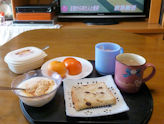
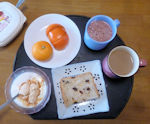
This photo shows my breakfast one week after my discharge (November 4).
Smoothie: Half an apple, half a can of diced tomatoes, a handful of blueberries,
a dash of black vinegar, and a little ice and water. Blend these ingredients
in a mixer. Makes about six servings.
Coffee: Added milk to the coffee I made two days ago.
Bread: Raisin bread made yesterday in a home bread maker.
Yogurt: Started with a starter culture about two years ago, and now I make my
own. Put 20% of this in a 1-liter container, add 80% milk, and leave it
overnight to make new yogurt. This morning, I topped it with kinako (roasted
soybean flour) and honey.
Dessert: Half a persimmon of my favorite and a mandarin orange.
6. Persimmons, my favorite
In essays and travelogues, I often mention that persimmons are my favorite
fruits. Once October arrives and the pear season ends, persimmons begin
to fill the stores. From then until the start of the new year, my taste
buds are in heaven.
“When I eat a persimmon, the bell rings at Horyuji Temple.”
From Shiki Masaoka's famous haiku verse, it seems that I am not the only
one who loves persimmons.
(From here down, no reading. Sorry.)
As expected, Shiki wrote many haiku praising persimmons. Here are a few
examples:
“渋柿や古寺多き奈良の町”
“奈良の宿 御所柿くへば 鹿が鳴く”
“柿くはぬ病に柿をもらひけり”
“我好の柿をくはれぬ病哉”
“側に柿くふ人を恨みけり”。
”風呂敷をほどけば柿のころげけり”
”三千の俳句を閲し柿二つ”
”宿取りて淋しき宵や柿を喰ふ”
”初なりの柿を仏にそなへけり”
”癒えんとして柿くはれぬぞ小淋しき”
”柿くふも今年ばかりと思ひけり”
“Many astringent persimmons and ancient temples in Nara”
“At the inn in Nara, eating Gosho persimmons, the deer cry”
"Sick with a persimmon-eating illness, I receive persimmons”
“I have a disease that prevents me from eating persimmons, which I love.“
”I resent the person eating persimmons beside me.“
”When I unfold the furoshiki, persimmons roll out.“
”After reading three thousand haiku, I eat two persimmons.“
”On a lonely evening, I eat persimmons at the inn.“
”I offer the first persimmons of the season to the Buddha.“
”I cannot eat persimmons to heal myself; how lonely.”
“I thought this year would be the last time I could eat persimmons.“
His close friend Natsume Soseki is no slouch either.
”柿落ちてうたゝ短き日となりぬ”
”樽柿の渋き昔しを忘るるな ”
”この里や柿渋からず夫子(ふうし)住む”
”渋柿も熟れて王維の詩集哉”
”渋柿や長者と見えて岡の家”
”能も無き渋柿共や門の内”
”Persimmons fall, and the days grow short.“
”Do not forget the bitter days of barrel persimmons.“
”In this village, where persimmons are not bitter, the master lives.“
”Even bitter persimmons ripen into Wang Wei's poetry collection.”
“Tannin-rich persimmons and the wealthy man's house on the hill.“
”Persimmons without tannin and the gate.“
Basho Matsuo also wrote such a verse.
”里古りて柿の木持たぬ家もなし”
”In this old village, there is no house without a persimmon tree.“
Here are three of my verses.
”柿喰ふてよくぞ日本に生まれけり”
2002年、イタリアにて
”モロッコに柿のありしか旅間近”
2010年、モロッコへの旅直前
”退院すぐ柿を食ひたし子規漱石”
今回入院中
”Eating persimmons, how fortunate to be born in Japan." 2002, in Italy
“Are there persimmons in Morocco? The journey is near.“ 2010, just before the trip to Morocco
”Upon discharge from the hospital, I longed to eat persimmons—Shiki and Soseki." During this hospitalization
Reading 15' 01"
|