|
 |
|
|
|
|
| 3. Time-killer |
|
|
When it comes to how to pass the time during hospitalization, I would say
watching TV, but lately I have been trying not to watch TV as much as possible.
Not only does it strain my eyes, but it also takes away both my sight and
hearing, leaving me frozen in front of the screen.
At home, I watch news programs, but I have nothing to do with dramas or
variety shows. The only program I never fail to record is “Go through the
Fine Weather! (晴天を衝け!),” which I watch whenever I want.
This time, I brought a portable radio, a smartphone, and three books.
1. Portable Radio
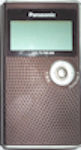 The portable radio, about half the size of my palm, is a companion at any
idle moment during the day and at bedtime. Especially during the first
three days after surgery when my body was restricted, it helped ease my
mood. I casually listened to the audio broadcast on NHK Radio 1, and when
getting bored, I simply turned it off. It was hassle-free and versatile.
“Hiruno Ikoi (Daytime Rest),” cheerful conversations, children's songs,
‘Radio Midnight Express (ラジオ深夜便),’... The portable radio, about half the size of my palm, is a companion at any
idle moment during the day and at bedtime. Especially during the first
three days after surgery when my body was restricted, it helped ease my
mood. I casually listened to the audio broadcast on NHK Radio 1, and when
getting bored, I simply turned it off. It was hassle-free and versatile.
“Hiruno Ikoi (Daytime Rest),” cheerful conversations, children's songs,
‘Radio Midnight Express (ラジオ深夜便),’...
|
| ………………………… |
|
2. Smartphone
The smartphone was more useful than I expected.
It was indispensable for communicating with my wife, but another thing
I've never done before is to become so familiar with my own voice. It's
convenient that today's smartphones can connect to the internet almost
anywhere in Japan.
Usually, when I go for a walk alone, I carry my phone and listen to it
using AFTERSHOKZ, a bone conduction wireless headset that hooks over the
ear. This way, I can hear the sounds around me at the same time, which
is safe. However, that’s about 30 minutes to an hour at most.
Here, since it’s a single room, I don’t need the headset. I can listen
as long as and whenever I want. In bed, like a portable radio, I can place
it by my pillow and listen properly.
As mentioned in the previous chapter, I select essays, travelogues, and
novels from the appropriate squares based on my interests. I may be flattering
myself, but the website “Viva, Seniors!” features works from over 20 years
ago, most of which include my own English translations. Since both versions
are read aloud by myself, it's a large volume. As a result of the recent
contract with a provider for a significant increase in website capacity,
I have uploaded approximately 450 hours of readings to the site. These
can be listened to comfortably in a hospital room. In fact, they have proven
to be a great help.
|
| ………………………… |
|
3. Books
I brought three books with me. “Opening the Tannishō ” (written by Kentetsu Takamori, published by 10,000 Years Hall Publishing), “Living English” (written by Shigeo Tobita, published by Chūōkōron Shinsho), and “Musical Journey” (written by former Prime Minister Junichiro Koizumi, published by Nikkei Premier Series).
Though not like Ryotaro Shiba's “If I were to take one book to a deserted
island,” I first chose this “Opening the Tannishō.”
“Even good people achieve salvation, let alone evil people.”
I am familiar with this phrase, which turns the principle on its head, as it appears in the original text, but I have not yet read it. Coincidentally, my wife had this book, which she said provided an easy explanation of it, so I decided to borrow it.
Written by Yuien, a disciple of Shinran, it borrows Shinran's words throughout
to correct misconceptions about the present situation—that much I understand.
I read up to Chapter 1, “Shinran's Words on the Essence of Buddhism,” and
Chapter 2, “Shinran's Clear and Unwavering Belief,” but felt a bit constrained
and gave up.
I had been reading “Living English” up to a certain point and planned to
read the rest in the hospital. However, I wasn't in the mood, so it remained
untouched.
So, I flipped through the paperback edition of “Musical Journey.”
The author, Junichiro Koizumi, was once known as an eccentric and multi-talented
individual. He played the violin and enjoyed a wide range of music, from
classical to rock. I don't know much about his athletic abilities, but
I recall seeing him frequently at sumo wrestling, professional baseball,
and soccer ceremonies on television.
I bought this book at Book Off with a price tag of 105 yen. I randomly picked it off the shelf and brought it to the hospital. I started reading it. To my surprise, I found myself drawn in by the content and finished it over a few days, including the surgery, feeling deeply impressed.
It is divided into three chapters:
1. Encounter with Classical Music
2. Opera is Love
3. Elvis, Morricone, and the Knight of the Journey
While I wouldn't say I'm not interested in chapter 2 and 3, my focus is on chapter 1, classical music.
The depth of his knowledge is extraordinary, both in breadth and depth.
I was amazed.
It all started when he played the violin in the school orchestra during
middle school. The pieces he performed were Haydn's “Toy Symphony,” Mozart's
Serenade “Eine Kleine Nachtmusik,” and Bach's “Air on the G String.” He
was captivated by the sound of the violin in each piece. That was the beginning
of his love for classical music, especially violin pieces.
Mendelssohn's “Violin Concerto” on the radio was his first step into classical
music. He rushed out to buy the LP. The B-side was Tchaikovsky's “Violin
Concerto.” He listened to both sides so much that they were worn out. He
also listened to Bach's “Violin Concerto.” These three pieces led him to
an enthusiastic fan of classical music.
(From here down, no reading. Sorry.)
|
| ………………………… |
|
Upon returning home, I immediately searched through my CD collection and found the next piece.
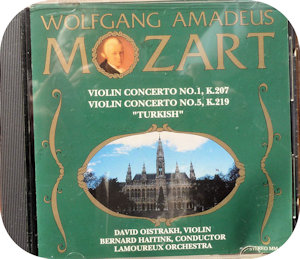
*Wolfgang Amadeus Mozart:
Violin Concerto No. 1 in B-flat major, K. 207
Violin Concerto No. 5 in A major, K. 219 “Turkish”
Violin: David Oistrakh Conductor: Bernard Haitink Orchestra: Lamoureux
Orchestra)
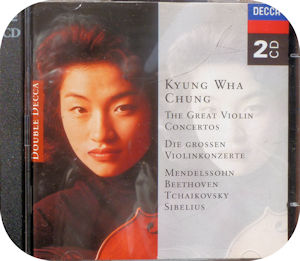
*Kyung Wha Chung "The Great Violin Concertos"
・Felix Mendelssohn "Violin Concerto in E minor, op.64" with Orchestre
symphonique de Montreal, conducted by Charles Dutoit
・Ludwig van Beethoven "Violin Concerto in D major, op.61" with
Wiener Philharmoniker, conducted by Kirill Kondrashin
・Pyotr Ilyich Tchaikovskiy "Violin Concerto in D major, op.35" with London Symphony Orchestra, conducted by Andre Previn
・Jean Sibelius "Violin Concerto in D minor, op.47" with London
Symphony Orchestra, conducted by Andre Previn
Selection of Junichiro Koizumi's
other favorite classical musics |
Let's enjoy these musics for a while.
The rest of the list below shows Mr. Koizumi's favorite musics. There are so many that I wonder how long I can keep up with them.
I'm a classical music fan myself, so I don't think I'll ever get tired of them.
Mendelssohn Violin Concerto
Bach Violin Concerto No. 2
Paganini: Violin Concertos, all 6 pieces
Mozart: Violin Concertos, all
Wieniawski: Violin Concerto No. 1
Bruch: Violin Concerto No. 1
Sibelius: Symphonies, all Finlandia Violin Concerto
Dvořák: Symphonies Nos. 7, 8, and 9
Smetana: My Country
Elgar: complete
Beethoven: String Quartets Nos. 7, 8, and 9 Violin Concerto Symphonies Nos. 3–8 Trio Piano Concertos Nos. 3, 4, and 5
Schubert, String Quartet No. 14 (Death and the Maiden)
Mahler: Symphony No. 5
Bruckner: Symphony No. 7
Berlioz: Symphonie fantastique Harold in Italy
Chopin: Piano Concertos Nos. 1 and 2
Tchaikovsky: Piano Concertos Nos. 1 and 2 Symphonies Nos. 4, 5, and 6 |
|
|
|
Reading: 11' 20"
|
|
|
|