English Conversation
I was a fool to assume that I’d be able to hold a proper English conversation
after just six months. Even students in their third year abroad still speak
broken English. I’ve come to terms with it to the point where I’d love
to meet anyone who can converse on equal footing with Americans after just
a year abroad.
Still, my goals—though I’m keeping this a secret from my company—are conversational English and travel, so I’m focusing my efforts on English rather than academics.
Perhaps because I’ve been fairly active and traveling all over the place, I’ve made a decent number of friends and gotten to know various families in town.
That said, language really is a difficult thing.
I’ve heard that previous students were told,
“You’ve been here a whole year, and this is all you can say?!”
Apparently, I’m in the same boat.
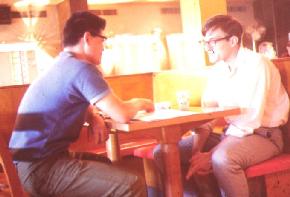 |
During a private lesson with the teacher Jack Luby |
Travels around the US
When I first arrived, I was surprised by the width of the highways and
the speed of the cars coming from San Francisco Airport, struggled with
finding restrooms and baths, and was put off by Western-style food, but
I’ve gotten used to it quite a bit now.
The other day, when I met Director N at the New York office and mentioned
our summer trip for the three with Japanese friends at Penn State , he
cautioned me,
“You’d better not talk about this too much at the company. Depending on the person, it might look like you’re just playing around, and some people might get jealous.”
Since I had already reported it to the HR department, I thought, “Oh no!”
Right after arriving, I embarked on a two-week trip:
San Francisco → Los Angeles → Denver → Sioux Falls → St. Paul → New York
→ State College
I learned how to use the restrooms and bathtubs, how to eat Western-style
food, and various other lifestyle habits.
(See “Penn State Newsletter 69.8, Part 4” addressed to Human Relations
Dept.)
A cross-country trip across the U.S. lasting nearly a month starting at the end of August
I met Associate Professor H from Tohoku University, and the two of us invited
graduate student I to join us.
We bought a tent for $50, loaded a kerosene stove and cooking gear into a Mustang, and set off on a three-person trip. We spent most nights of the 26-day trip in the tent, and I was in charge of cooking. Campsites were free or cost only a dollar or two. We bought food at supermarkets along the way.
On the way there from State College, we took the southern route to Los Angeles. We saw the Pacific Ocean in Santa Monica. On the way back, we took the northern route.
We switched from film to slides, buying long rolls of Ektachrome at a bargain price from E’s lab and winding them into cartridges ourselves—a truly painstaking effort to save money. I’m satisfied that the photos turned out relatively well.
We encountered some serious dangers, and the car broke down frequently, but more than anything, the magnificent scenery at every turn gave me a deeper understanding of America and the American people. I made the most of the opportunity and had a great experience.
(See “26-Day Trip with Three People”)
Friends at Penn State
As for friends, besides Mark, I made quite a few other friends.
Since I’ve made a conscious decision not to socialize with Japanese people, Mark and the others have been especially considerate toward me.
(See “Penn State Newsletter to the Personnel Department 70.5 · Part 2”)
I do regret that I should have socialized more with Japanese students,
but considering the one-year study abroad period and my goal of mastering
English conversation, perhaps it couldn’t be helped. I’ll conclude this
report here.
Part2 Reading (7:27) on
Total Reading 15:13
|